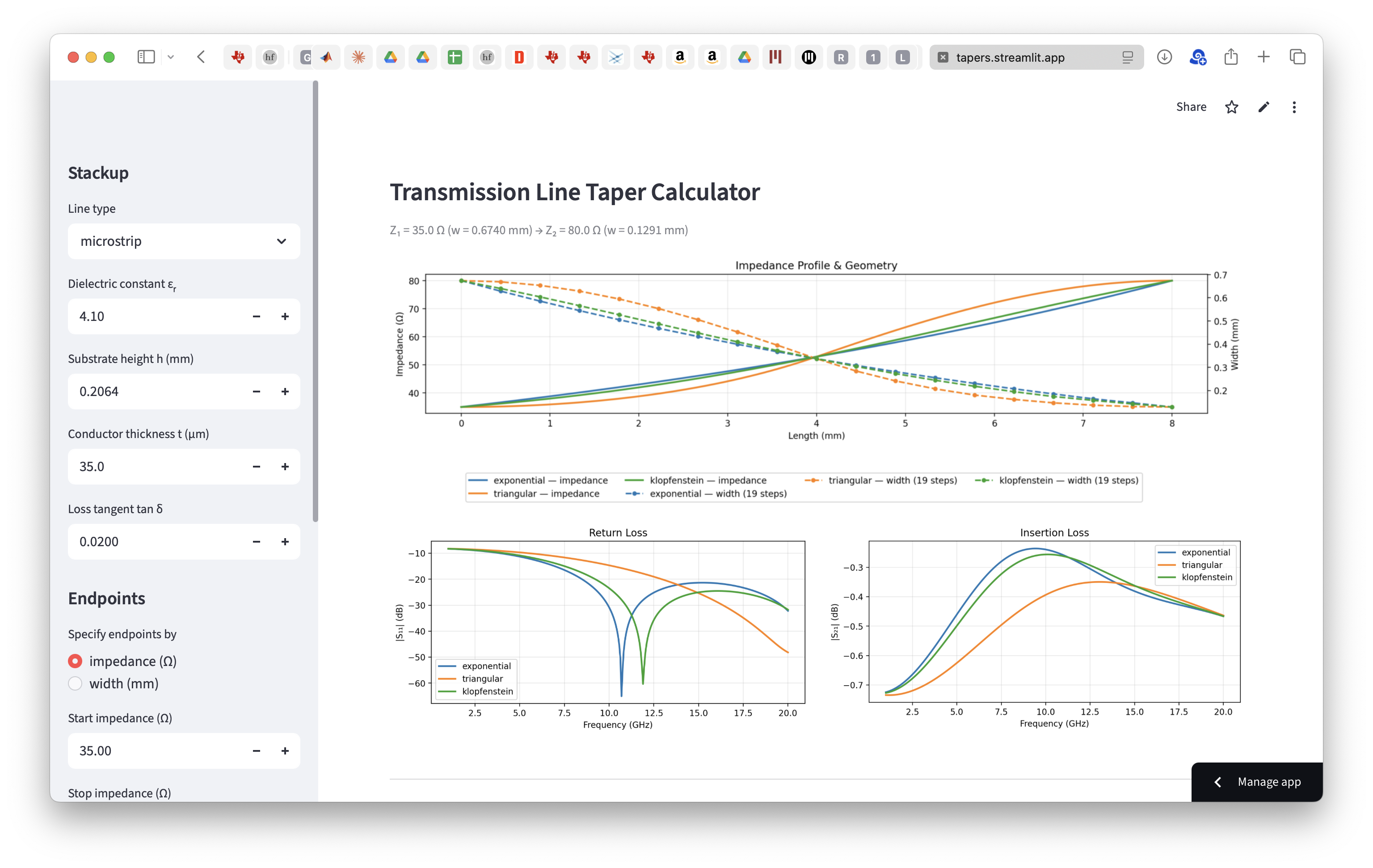
It is fairly common to need to adapt between line widths on an rf board, for example when connecting between a transmission line and a RFIC. The fix for this is to create an adiabatic taper between the two widths to reduce reflections at the mismatch. Three common taper types are the exponential, triangular, and klopfenstein.
These tapers are simple geometry to generate but annoying to draw. Also, they are typcially defined as a function of impedance (the impedance tapers by the profile) which is somewhat unhelpful since geometry is strongly nonlinear in the impedance. This means that drawing them isn’t as easy as just drawing a spline. Thus it would be nice to easily generate tapers that you can import into your design.
Behold - taper calculator!
tapers.streamlit.app
It supports tapers between defined impedances or widths, and the taper itself is computed in impedance using design equations from Pozar for the microstrip model and Waddel’s for the CPW with ground model. These models have practically negligible error for this application because the tapers is already extremely low loss; your analysis should be more holistic in comparing taper types and lengths. It also supports dxf and s2p export.
Theory
What defines a ‘good’ taper is high return loss and low insertion loss. Reflection coefficient $ \Gamma $ on a continuous line is defined as a ratio of impedances:
\[\Delta \Gamma= \frac{(Z+\Delta Z)-Z}{(Z+\Delta Z)+Z}= \frac{\Delta Z}{2Z}\]As $\Delta Z$ tends to zero, this becomes a derivative:
\[d\Gamma=\frac{1}{2}\frac{d}{dz}\ln\left( \frac{Z}{Z_{0}} \right)\]Thus by integrating:
\[\Gamma(\theta)=\frac{1}{2}\int _{z=0}^l e^{-2jl\beta z}\frac{d}{dz}\ln\left( \frac{Z}{Z_{0}} \right)\, dz\]This is known as the theory of small reflections, and it is covered in most textbooks. The problem with this method is that it cannot handle multiple reflections or large reflections, making it fairly inaccurate for larger discontinuities.
Instead, the calculator models each small section of the taper with the ABCD matrix for a line:
\[\begin{pmatrix} A & B \\ C & D \end{pmatrix}=\begin{pmatrix} \cos(\beta l) & jZ_{0} \sin(\beta l) \\ \frac{j}{Z_{0}}\sin(\beta l) & \cos(\beta l) \end{pmatrix}\]Then you can chain all the sections together and write the reflection coefficient (or any of the s parameters) exactly:
\[\Gamma=\frac{AZ_{l}+B-CZ_{0}Z_{L}-DZ_{0}}{AZ_{l}+B+CZ_{0}Z_{L}+DZ_{0}}\]There are three types of common tapers: triangular, exponential, and Klopfenstein. In general, triangular is worst, exponential has early rolloff but passband response isn’t super good, klopfenstein is opposite with worse rolloff but best optimal passband response 1.
Hfss Test
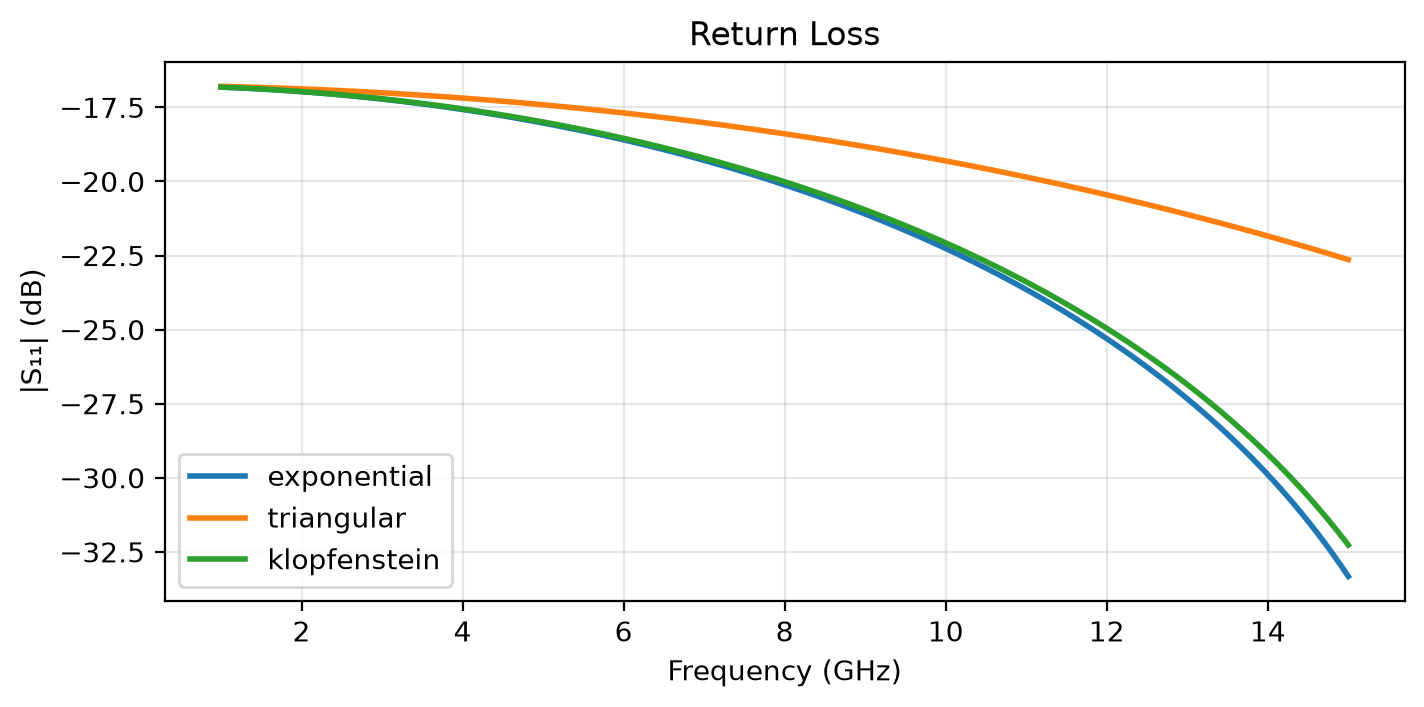
I was curious about how well the calculator matches hfss and decided to test it for a project I needed a taper for. Here’s the calculator output:
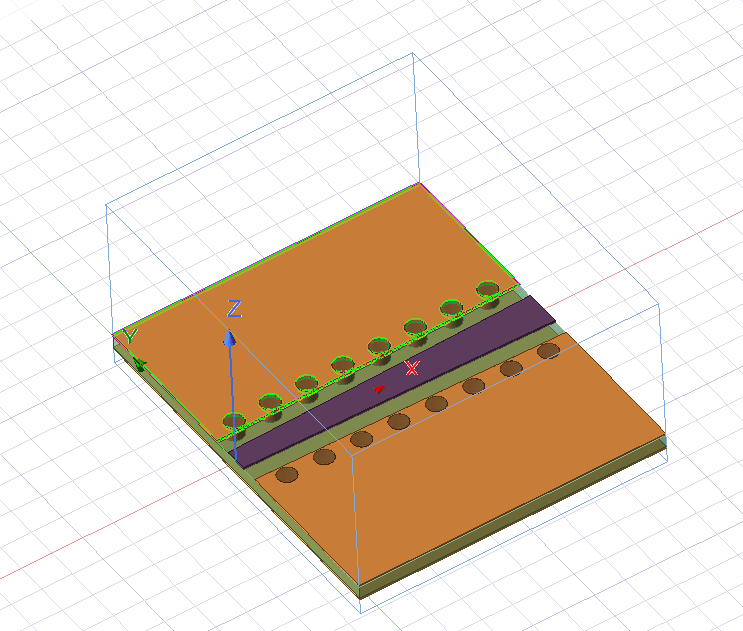
I exported the exponential profile dxf and dropped it in hfss:
And the measured S parameters:
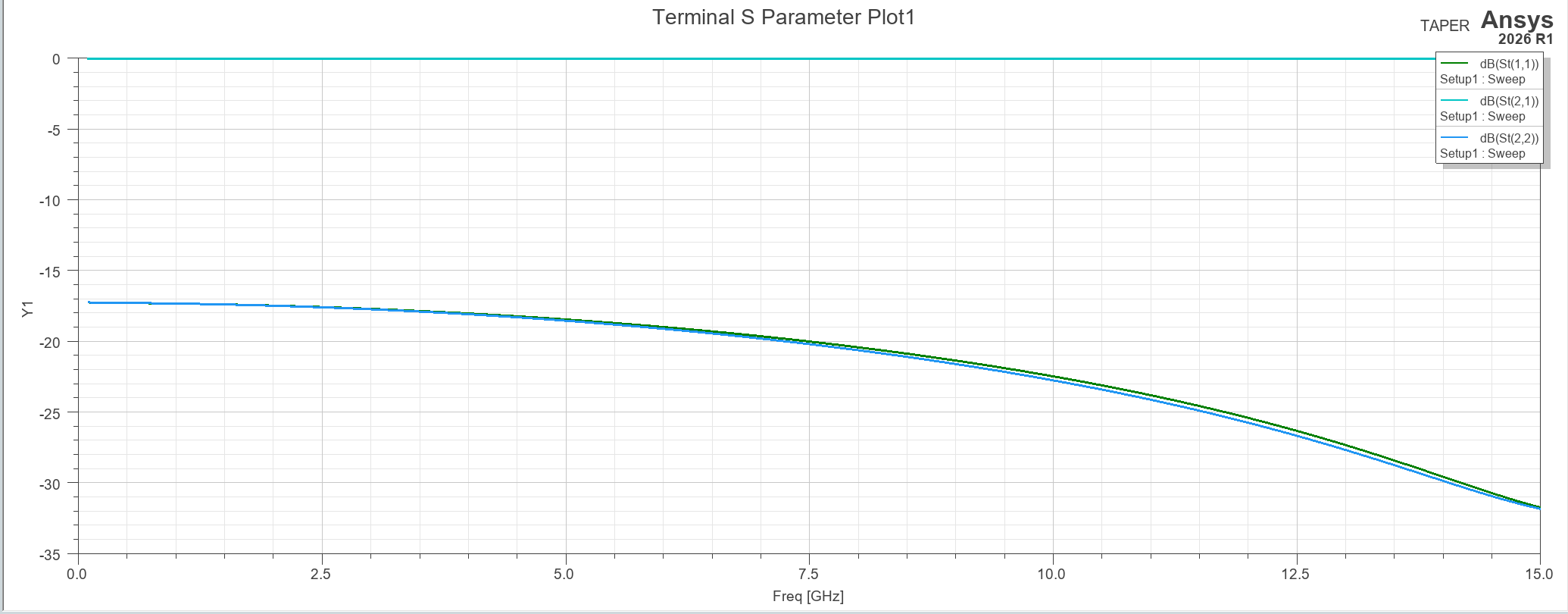
Pretty pleased with the agreement!
-
Klopfenstiein taper is a stepped chebyshev transformer with infinite steps, so chebyshev-like behavior (this slow rolloff but great passband response) is expected. ↩